
Webinar: AI That Delivers: Transparent and Defensible Pop Health Opportunity Identification
May 13, 2026
A discussion with Ursa Health on how deliberately designed AI can help prioritize high-impact areas by combining clinical, financial, and utilization data to support more targeted pop health management strategies, while still maintaining trust and transparency in the underlying methodology.
Introduction
In this NAACOS Innovation Spotlight session, Ursa Health Vice President of Growth Tiffany Wandy joined Chief Technology Officer Steve Hackbarth and Analytics Engineer Catherine McQuaid to examine how agentic AI can be used for population health opportunity identification without sacrificing methodological rigor. The conversation focused on making a concrete case for redesigning analytics workflows around governed automation instead of simply layering a chatbot onto an organization’s existing BI stack.
This is a summary of key takeaways from the conversation. You can check out the full recording below.
Summary
- The Future of Analytics is Not Another Chatbot
17:00 Steve Hackbarth began with the prevailing model for enterprise AI: use it to augment qualified experts who can direct the work, review the output, and ultimately take responsibility for the result. He described this as treating AI “like an intern,” which is a useful and appropriate approach that can increase workforce capacity without lowering the standard of accountability.
But augmentation alone, he argued, solves only half the problem. It may help analysts work faster, yet it still leaves organizations dependent on scarce expert capacity to initiate, supervise, and validate every analysis. To identify and prioritize population health opportunities at greater scale, Ursa had to move beyond expert-assistance tools and explore deliberately governed, largely unsupervised AI workflows capable of performing more of the analytical process independently.
21:00 Most healthcare organizations remain caught between two imperfect options. Pre-built dashboards are automated, accessible, and generally trusted once their measures have been validated, but they cannot improvise. They show what their developers anticipated, not necessarily what a clinical or operational leader needs to understand today. Custom analysis provides the missing flexibility, but it consumes scarce analyst capacity and often turns seemingly straightforward follow-up questions into multi-day work queues.
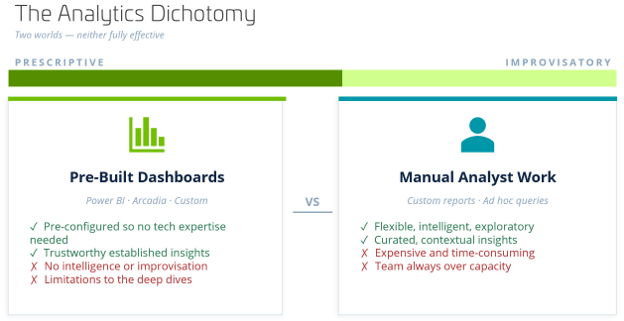
Catherine McQuaid described the familiar sequence: an analytics team spends hours building what is intended to be a one-stop dashboard, publishes it, and immediately begins receiving requests to explain a measure, segment the results by provider group, or investigate an unexpected trend. Business and clinical leaders are frustrated because they cannot act without the additional detail; analysts are frustrated because they cannot prioritize or satisfy the volume of incoming requests.
“Most organizations have a plethora of rich data,” McQuaid said. “But it’s getting to that next layer of actionable insights that really poses the challenge.”
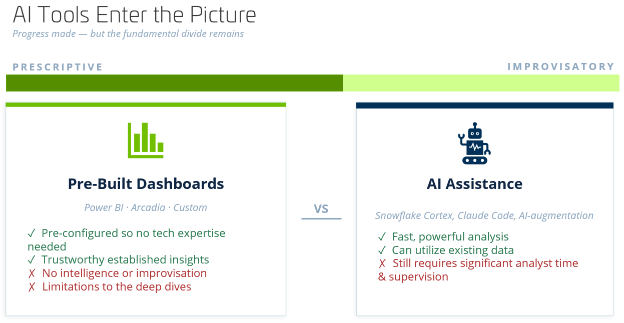
24:00 AI assistance makes the custom-analysis side more efficient, but it does not eliminate the divide. Analysts still supervise the work, technical expertise remains a gating factor, and the static dashboard remains static.
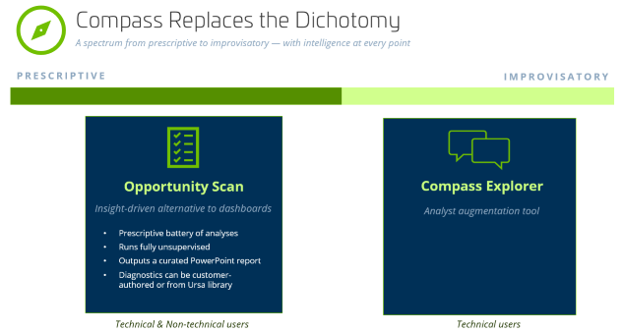
25:00 Ursa’s innovation is agentic AI that can instead be used to transform the automated side of the spectrum: replacing a fixed dashboard with a largely unsupervised workflow that runs a governed sequence of analyses, identifies material findings, drills into the most relevant results, and curates an executive-ready artifact for review.
Hackbarth argued that this constitutes a distinct product category. It is not an AI chatbot bolted onto Power BI, and it is not merely a faster SQL assistant. It is an “AI-first, true analytics workflow orchestration tool” that combines the repeatability of a pre-built product with a constrained form of analytical judgment. Critically, that distinction should shape how health tech leaders evaluate products: a tool that helps an analyst work faster and a tool that independently executes a validated analytic workflow solve different problems and require different controls and evaluative frameworks.
- The Data Model, Not the AI, Defines What Can Be Trusted
The Ursa team posited a very clear boundary: an AI agent can operate with substantial autonomy at the analysis layer, but it should not be trusted to create the underlying healthcare concepts on which that analysis depends.
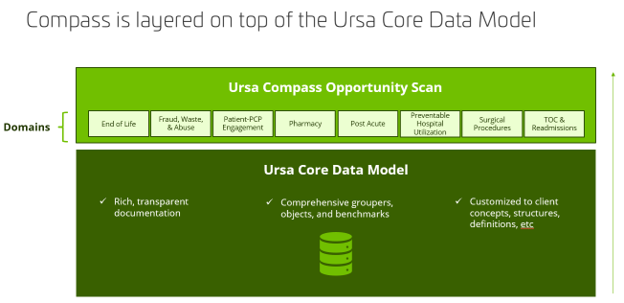
26:00 Ursa’s Opportunity Scan sits as a deliberately thin AI layer on top of the Ursa Core Data Model, which the company has developed over the course of more than a decade. The tables, measures, clinical concepts, financial logic, and operational definitions are built and hydrated by humans, then validated directly with customers, with the model localized to each client’s contracts, data sources, workflows, and expectations.
“We absolutely do not trust unsupervised AI to build new tables, to apply new clinical concepts, or do anything in the realm of what we would call analytics engineering,” Hackbarth said.
The AI is not asked to invent an avoidable-admission definition, determine how attribution should work, or decide which claims fields constitute a particular value-based care measure. Those concepts must already exist in a validated data substrate.
That architecture gives the agent a much narrower and safer task when conducting an analysis. Rather than asking a probabilistic model to interpret raw claims, clinical feeds, attribution logic, and contract-specific definitions all at once, the system limits it to validated measures and a governed semantic layer.
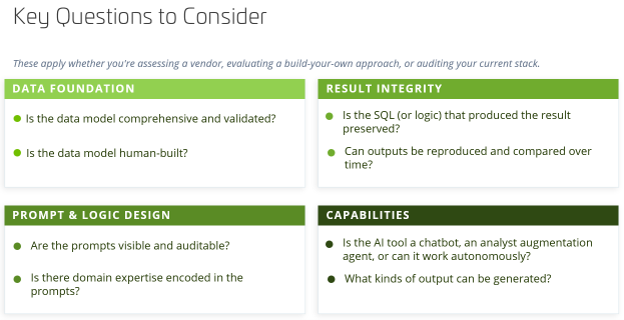
37:00 This approach creates a practical readiness test for organizations considering AI analytics. The first question is not whether the organization has selected a large language model or enabled an enterprise chatbot. It is whether the relevant measures and concepts already exist in a comprehensive, accurate, and sufficiently detailed data model. If analysts are still rebuilding definitions for each report, AI may accelerate the inconsistencies rather than solve them.
Tiffany Wandy summarized the risk plainly: applying AI to fragmented or poorly structured data leads to “accelerating bad analyses and scaling bad decision making.” Health systems and enablement organizations therefore should resist treating foundational data work and AI adoption as competing investments. A validated data model is not the work organizations complete before moving on to AI, but rather the necessary foundation that makes higher-autonomy AI possible.
- Prescriptive Prompts Can Encode Domain Expertise Without Turning the Workflow Back into a Dashboard
28:00 A major guardrail built to ensure trust is a set of highly prescriptive prompts that define exactly what the agent should analyze. In the preventable emergency department visit example shown, the prompt specified the measure within the Ursa data model, the filters to apply, the attribution method, the analysis to perform, and the key results to return.
This is materially different from giving an agent a broad instruction such as “find cost-reduction opportunities.” The diagnostic prompts are already aware of the relevant tables and columns and do not depend on the agent to infer the intended measure. In that sense, the workflow resembles a pre-built population health dashboard in that the analytical objective and core methodology are predetermined.
The counterintuitive point is that prescription does not eliminate useful improvisation. The workflow can be fixed at the level of the questions it must answer while remaining dynamic at the level of what it investigates next. In the demonstration, one session evaluated which diagnoses were driving potentially preventable ED visits. The following session then instructed the agent to take the top driver identified in the prior analysis and perform a deeper investigation.
Because the leading diagnosis will vary by ACO, provider group, market, or patient population, the next-level analysis is not pre-authored in the way a dashboard drill-down would be. The agent follows a governed branching path based on the actual data. Ursa refers to this as constrained improvisation: the model is allowed to adapt, but only within a domain, methodology, and set of tools that have already been defined.
That design pattern is likely to be more important than prompt cleverness. Organizations do not need a single perfect prompt capable of reasoning through every population health question. Instead, Ursa’s library of bounded workflows embed clinical and actuarial expertise, expose the appropriate tools, reference validated measures, and define when the agent should branch or stop.
McQuaid suggested that domain expertise encoded in the prompts may be one of the clearest dividing lines between a powerful general-purpose agent and a system built specifically for healthcare analytics. Buyers should ask whether prompts are visible, auditable, editable, and reproducible, as well as whether they contain recognizable value-based care logic rather than generic instructions wrapped in healthcare terminology.
- The Most Trustworthy Output is Not the Model’s Narrative, but an Immutable Result that Can Be Traced Directly to the Underlying SQL
30:00 Another of Ursa’s guardrails addresses one of the most persistent weaknesses in generative analytics: a polished narrative can misstate or embellish the underlying result even when the query itself is sound.
In the demonstrated workflow, every query executed by the agent is saved as a distinct table containing the direct result of the SQL. The agent cannot edit that result table after the fact. Each promoted finding can be traced back to both the SQL and the database output, allowing an informed reviewer to verify whether the correct tables, fields, filters, and calculations were used.
This approach creates a hierarchy of trust. Free-text reasoning is useful for navigating the workflow and explaining the results, but it is not itself treated as the authoritative analytic artifact. Only findings tied to saved query results can be promoted into a user-facing presentation. The model may decide which findings to emphasize or how to organize the story, but it cannot substitute an unsupported statement for a database result.
The approach does not completely eliminate erroneous SQL. An agent can still query the wrong cohort or apply the wrong constraint. The difference is that the mistake is inspectable. In many black-box AI products, the user receives an answer with little practical ability to reconstruct how it was reached. Here, trust does not depend on assuming the model behaved correctly; it depends on preserving enough lineage for a technical user to prove whether it did.
McQuaid advised buyers to look beyond one-time transparency. Results should be reproducible and comparable over time. If the same prompt yields a materially different methodology each time it runs, the organization cannot distinguish true performance changes from model variability. Auditability therefore includes the prompt, the SQL, the source results, and the ability to rerun the process consistently.
For health tech executives, “explainable” should not mean that the model can generate a plausible paragraph describing its reasoning. It should mean the system exposes the methodology and maintains a durable connection between every promoted claim and the underlying data.
- AI Becomes Operationally Valuable When It Produces a Reviewable Case for Action
33:00 To show what a governed approach looks like in practice, the presenters walked through Ursa’s Opportunity Scan, which is designed to move from broad population health signals to a prioritized, decision-ready set of findings. The workflow runs in two phases. First, the system executes a series of diagnostics across domains such as ambulatory care-sensitive admissions, preventable ED visits, and care transitions. Second, it curates the validated findings into a presentation that prioritizes the opportunities and assembles a data story for a clinical, operational, or executive audience.
In the example shown, the agent identified three actionable opportunities. For preventable ED utilization, it determined that fluid and electrolyte disorders were the primary diagnosis driver, presented the supporting evidence, recommended potential interventions, and calculated the financial opportunity associated with reductions ranging from 25% to 75% in the targeted population. It then supported the recommendation with annotations, trends, and visualizations based directly on the query results.
This is a meaningful departure from a chatbot that returns a paragraph or a table after each question. The deliverable produced by Ursa’s Compass agent is designed to enter an existing management workflow in that an informed user can review the presentation, challenge the assumptions, ask follow-up questions, and decide whether the opportunity warrants operational action.
The presenters were explicit that the artifact should not be distributed without human review.
“That would be crazy,” McQuaid said. “There is no way to pull humans completely out of the loop.”
The ambition is not to automate accountability; it is to automate enough of the analytical production process that the human can spend more time evaluating the recommendation than assembling it.
That distinction matters for workforce design. The relevant measure of AI value is not how much analyst labor can be removed from a task. It is whether the system changes the starting point of human work. Reviewing a fully assembled, traceable opportunity assessment is materially different from receiving a ticket to build the assessment from scratch.
- AI’s Strength is Relentless, Structured Exploration
43:00 The discussion’s most fully operationalized example began with an organization-level view of admissions per thousand. The agent detected that one partner was performing above the organizational average, identified congestive heart failure as a contributing population, and continued narrowing the analysis until it found just over 100 patients with heart failure who were repeatedly cycling through inpatient admissions.
That list could be handed directly to a population health or care management team to assess whether the patients were already enrolled, whether outreach frequency should increase, or whether another intervention was warranted. The clinical reasoning was not exotic; the value came from consistently moving from the broad signal to the actionable cohort without requiring an analyst to perform each step independently.
McQuaid offered similar examples of the branching logic an agent could apply. A spike in admits per thousand might be concentrated in a specific market. Within that market, the agent could identify the diagnoses or populations driving the increase. A chronic kidney disease cohort might be presenting with uncontrolled anemia that could potentially be managed more effectively in an outpatient setting. Congestive heart failure patients might be admitted for conditions other than heart failure itself, revealing an intervention opportunity that would be missed by a narrowly coded CHF report.
44:00 Hackbarth described healthcare data models as containing “innumerable treasures up in the attic.” Many valuable findings do not require advanced machine learning; they require splitting, summing, filtering, comparing, and then repeatedly investigating the result behind the result. The limiting factor is often not analytical complexity but the time required to canvas all the plausible combinations.
This is a compelling use case for agentic systems because machines are well suited to patient, repetitive exploration. Rather than asking AI to discover a completely new clinical phenomenon, organizations can use it to inspect far more of the validated analytic space than a constrained human team can reasonably cover.
- Scaling AI Now Depends on Boundaries, Permissions, and Oversight
By 2026, Hackbarth argued, the models are already strong enough to perform much of the analytical work we require. The central question is no longer whether next year’s model will finally make governed population health analytics possible. It is how much autonomy organizations should permit, for which users, and inside which boundaries.
46:00 The immediate product frontier lies between two endpoints. At one end is Explorer, Ursa Compass’s analyst-augmentation capability, where a skilled user directs a flexible AI assistant. At the other is Opportunity Scan, a managed and highly prescriptive workflow that can operate largely independently. The emerging middle ground would allow a clinical or operational user to enter a completed diagnostic session and ask follow-up questions without being fluent in SQL or returning every question to the analytics team.
That middle ground is commercially and operationally attractive, but it raises harder permissioning questions. How tightly should the follow-up topic be scoped? Which data tools should a non-technical user be allowed to invoke? When does flexibility become unsafe? What output can be acted on directly, and what must return to an analyst for validation?
Hackbarth did not claim those questions had been fully resolved. His more important point was that improving model performance will not remove them.
“I don’t think they’re ever going to be, or at least in the next several years, reliable enough that they can purely be worked in an ungoverned way,” he said.
The next phase of adoption therefore belongs as much to product governance, role design, auditability, and workflow architecture as to model development.
12:30 The webinar poll reflected how early the market remains. With approximately 54% of attendees responding, most reported using generic AI tools, while only about 13% were using population health-specific AI products. A substantial portion of the group reported no AI use at all. That gap is unlikely to close through broad access to generic AI alone. It will close when healthcare organizations establish credible operating models for applying increasingly capable agents to trusted data within clearly defined boundaries.
- Conclusion
When AI is deliberately designed around validated measures, prescriptive workflows, transparent SQL, and human review, it can be trusted to synthesize clinical, financial, and utilization data into a prioritized view of where intervention is most likely to have an impact. The infrastructure requirement is consistent: organizations need a governed data model that can connect patient-level activity, cost, and outcomes while preserving the lineage behind every recommendation. By moving beyond static dashboards and loosely constrained chat interfaces, population health teams can focus limited operational resources on the patients, conditions, and interventions with the greatest potential impact, without losing the trust of clinicians that’s taken years to build.
Get in Touch with Ursa Health
8:00 If your organization is navigating the complexities of implementing a pop health platform incorporating AI-native intelligence and you’re looking to build AI workflows that are transparent, explainable, and analytically defensible, reach out to the team at Ursa Health.
Chief Technology Officer, Steve Hackbarth: shackbarth@ursahealth.com
VP of Growth, Tiffany Wandy: twandy@ursahealth.com
Analytics Engineer, Catherine McQuaid: cmcquaid@ursahealth.com